
• Please review our updated Terms and Rules here

16 colors driver for Sierra Adventures

1ST1

Veteran Member
Joined
Oct 21, 2014
Messages
2,190
Location
near frankfurt/m, germany
Hello, there is a github project to proviode 16 color drivers for Sierra Adventures. It was made for the Hercules/CGA combo graohics cards like Plantronics ColorPlus and those which are used in several Commodore PCs (PC 20-III and others) which can support a 320x200 16 color modes.
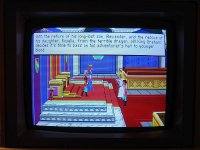
kq4_1084.jpg


  • Codename: ICEMAN
  • Conquests of Camelot
  • Hoyle's Book of Games 1
  • Hoyle's Book of Games 2
  • Hoyle's Book of Games 3
  • King's Quest I (SCI)
  • King's Quest IV
  • Leisure Suit Larry 1 (SCI)
  • Leisure Suit Larry 3
  • Mixed-Up Mother Goose
  • Police Quest II
  • Police Quest III
  • Quest for Glory I
  • Quest for Glory II
  • Space Quest I (SCI)
  • Space Quest III
  • The Colonel's Bequest

See here: https://github.com/roybaer/foss_sci_drivers

There is the driver and well documented source code. Maybe someone has fun to add more special video modes, like the Olivetti M24 modes?
 
There is the driver and well documented source code. Maybe someone has fun to add more special video modes, like the Olivetti M24 modes?

The M24 has only two "extra" modes: Regular 320x200x4 but with two video pages, and 640x400x2 (black and white). Multiple video pages aren't used in Sierra games IIRC, so that leaves 640x400x2. I can't see the advantage of doing that -- the text would be higher-res, but the pattern dithering would look worse than 320x200x4 (even on a monochrome monitor, as the M24 shows CGA colors as 16 shades of green on the mono monitor). So I'm afraid I don't think it offers anything over regular CGA in this application.

Now, the M24 DEB (Display Enhancement Board) *can* display 16 colors, also at a resolution of 640x400. So, such a driver would not only be in 16 colors but the text would be higher resolution like it is on Hercules. However, the total audience of such a driver would be literally myself: Last I checked, I have the only known working DEB in the world. So I'm not going to spend weeks writing a driver just for myself that I don't need :-)

Does a Dec Rainbow or Tandy 2000 driver exist? Those can do 640x400 in 8 colors, and there are more of those (at least 5-10) working in the world.
 
Interesting I've got an Amdek MAI enhanced CGA card that can do 320x200 16 but it isn't compatible with anything. I wonder how hard it would be to modify this driver for that? I don't know of any programming specs, other than the fact that Dr Halo II supports that card.
 
Fantastic job! Finally something fun to try with ColorPlus compatible boards.

and those which are used in several Commodore PCs (PC 20-III and others) which can support a 320x200 16 color modes.

Does this mean ATI Small Wonder cards? If so, I think they are also used in Amstrad/Schneider PC1512.

Extensions of files are *.s, but syntax is nasm. I thought nasm uses *.asm usually and gcc/binutils with their unusual AT&T style syntax use *.s.
 
Last edited:
Interesting I've got an Amdek MAI enhanced CGA card that can do 320x200 16 but it isn't compatible with anything. I wonder how hard it would be to modify this driver for that? I don't know of any programming specs, other than the fact that Dr Halo II supports that card.

Without specs, someone will have to own the card, trace through Dr. Halo II running on it, and reverse-engineer the driver.
 
Does a Dec Rainbow or Tandy 2000 driver exist? Those can do 640x400 in 8 colors, and there are more of those (at least 5-10) working in the world.

AFAIK there is no support in any Sierra titles for T2K. Also Tandy shipped the STB-400 card for the 1200 and even 1000 series that could also do 640x400x8 on a CM-1 color monitor (same monitor used with the T2K). They called it the Tandy Deluxe Color Graphics Adapter - but it still had STB badging.
 
Where have I seen that driver and screenshot before? A Plantronics 16 color driver! Color me surprised!

(They're mine.)

I'd like to add a couple of things:

  • It is an SCI0/SCI01 driver and therefore not usable with 256 color games, AGI games or anything else.
  • The list of supported titles is not exhaustive, though. It merely lists what has been tested.
  • There is a Sigma Designs Color 400 driver, as well, because the programming models are very similar.
dahu said:
Does this mean ATI Small Wonder cards? If so, I think they are also used in Amstrad/Schneider PC1512.
Yes, it does run on an ATI Small Wonder (see screenshot), but no, the PC1512's VDU is incompatible. There is an official driver (PC1512.DRV) for it, though.

SomeGuy said:
Interesting I've got an Amdek MAI enhanced CGA card that can do 320x200 16 but it isn't compatible with anything. I wonder how hard it would be to modify this driver for that?
Well, if you find out how that card works and then tell me and it happens to use the same memory model as the ColorPlus or the Color 400, then I might be willing to adapt the driver for it.
 
Addendum:

I have successfully tested the driver with KQ5EGA, yesterday, which means that it works with the dedicated 16-color versions of SCI1 games, as well.
Those games had separate 256-color and 16-color versions that were commonly known as "VGA" and "EGA" versions despite their driver model.
This should push the number of supported titles to approximately 30.

Also, since it had not been linked, yet, this is a list of SCI games: https://en.wikipedia.org/wiki/List_of_Sierra's_Creative_Interpreter_games
 
Could please tell what configuration need to install in the 86box for the Sigma Designs Color 400 graphics card to work?
 
[1982] 20286, [ISA] Commodore PC-30 III, [ISA] Sigma Color 400 — gives a BIOS error but after pressing F1 it boots.
 
Yevrowl I have no issues running it on my existing XT and 286 profiles (Super PC and Trigem VULCAN-II), 86box v6.0


1783776207662.png
 
I think wiki needs year of release, maybe info on what type of monitors it drives, that should be it.

P.S. "competing with EGA" line should be avoided as this is not a EGA competition, its just another beefed-up-with-VRAM CGA.
Most of those are failed products and I see no reason this one shouldn't be either (given the obscurity). As such it cannot be competetive to EGA.
 
I'm not really familiar with the Color 400, but it seems like most of the wiki info comes from here, including "designed to compete with the EGA."

In appears the card supports 16 colors in 320x200, 640x200, and 640x400. This is on par with EGA, minus the 64-color palette. In hindsight, to truly be competitive with IBM's EGA, a card needed to be hardware compatible. But I don't know if that was the general consensus in 1985.
 
In appears the card supports 16 colors in 320x200, 640x200, and 640x400. This is on par with EGA, minus the 64-color palette. In hindsight, to truly be competitive with IBM's EGA, a card needed to be hardware compatible. But I don't know if that was the general consensus in 1985.

I guess if we're going to be nitpicky about the meaning of "competitive with EGA" it looks like the other thing it's missing is redefine-able characters in hardware text mode. From a design perspective a thing that's slightly interesting about it is in graphics mode it logically has four planes like EGA/VGA, but hardware-wise it just has two banks of 4164-style DRAMs. That means in 16 color mode it technically hits memory "twice as hard" as an EGA card does. (IE, its memory clocking would have to be similar to CGA text mode.) I would be curious how well it performed; if it has snow surpression it probably would generate a lot of wait states.

On the bright side it was probably cheaper than EGA when it came out, the 4-bit wide DRAMs EGA used were significantly more expensive than the same amount of DRAM from the 1-bit parts for a few years. It's also pretty clever how they engineered the 320x200 and 640x200 16 color modes so they're just layered on top of the native CGA 320x200x4 and 640x200x2 modes. (It's a lot like a Plantronics card in this respect, although the resulting memory map is different. It also shares with the Plantronics card the fact that the 320x200 mode is a gross combination of fat and planar pixels, not pure planar like EGA... and that all modes have line interlace similar to CGA.)

P.S. "competing with EGA" line should be avoided as this is not a EGA competition, its just another beefed-up-with-VRAM CGA.
Most of those are failed products and I see no reason this one shouldn't be either (given the obscurity). As such it cannot be competetive to EGA.

In terms of taxonomic classification I would compare this board pretty evenly with the Display Enhancement board for Olivetti machines. Both are "comparable to EGA" in the sense they have planar 640x400 16 color modes with palettes, but both could *also* be described roughly as being CGA cards with extra RAM and bells and whistles tacked on. Within a plane both have CGA-esque memory layouts with line interlacing, instead of EGA's linear layout, so from that perspective both are "SuperCGA". Beyond that, if we compare and contrast:
  • The Sigma card has a plane select register like EGA, the DEB requires 128K of contiguous space from A000 to BFFF to have all four planes present.
  • DEB has that goofy LUT feature that lets it automatically dither colors to fake something closer to EGA's 64 color palette, the Sigma just has a normal palette register.
  • Sigma has 16 color lower res modes, the DEB only has 640x200 and 640x400
  • The DEB has that overlay mode that let's you treat it as a 640x400x8 overlay separate from whatever the onboard video is doing. (EGA has nothing like that.)
  • The Sigma could co-reside with an MDA card, since it bank switches inside of B8000 instead of conflicting. (EGA can also do this.)
In short, it's kind of a wash which one is more "like" EGA. All of these cards are pretty standard fare for the time; planar was *the* way to do higher color video systems at the time simply because RAM was pretty harshly bandwidth limited.
 
In terms of taxonomic classification I would compare this board pretty evenly with the Display Enhancement board for Olivetti machines.

I would say DEB is more elaborate, and then EGA/VGA are far more elaborate. Compared to MDA, CGA.

My classification goes MDA/CGA on one side, EGA/VGA on the other. Simple vs complex. There is stuff in between, where I would place DEB.

Reason of course the EGA/VGA pipeline where EGA has 5 controller chips and the predecessors have only a CRTC, sequencer and GC do not exist, which gives a lot more power to the user in managing the picture output via setup and register operations, opposed to doing everything by raw CPU I/O completely prepared for graphics card format.

Case in point would be Commander Keen where the same looking game should be possible on CGA+ system like Plantronics, but it really isn't, because there are no EGA facilities. It is going to both scroll worse and redraw slower.

DEB, also has more than framebuffer, as far as I remember it can compose two things, I think text on bitmap, and it also has both scrolling registers done correctly (not sure if it's 4px I think it is due to 6845), for me that also points to Olivetti thinking hmm writing 128kb VRAM all the time even on 16-bit 8086 isn't very sexy, lets add some features to accelerate some basic use cases. Wasn't there also a feature of redefining characters and magnifying them for display or composition? It all basically reeked of "free sprites" if you turn on the game mindset.

We can also mention the PGC which has a minicomputer on board to assist the affairs.
 
It also shares with the Plantronics card the fact that the 320x200 mode is a gross combination of fat and planar pixels

I think they (Plant) just expected people to adapt existing CGA code to run twice. You can count on your hands how much Plantronics supported apps are there in mid 80s, if they had their own memory layout, it would be probably near 0.

On the bright side it was probably cheaper than EGA when it came out

It had to be a lot cheaper with the same amount of RAM, because it's a CGA...
Hence the reason why I feel it can't compete with EGA. It competed in a hole IBM left when making EGA a more complex display system opposed to just slapping on extra RAM and charset RAM on CGA.

Competition requires both ways, I mean do you feel Sigma or Plantronics were ever the topic of a high profile IBM meeting?
 
Back
Top