
• Please review our updated Terms and Rules here

PET 64K add-on board make by Paradox INC

AndyG

Experienced Member
Joined
Oct 11, 2016
Messages
437
Location
UK
Hello,

I have a 64k addon board made by Paradox Inc for the Commodore PET and wondered if anyone has come across it (I have spoken with JonB who also has one but with no documentation sadly) ?

I ran the 8296 diagnostic program which told me I have a few bad ram chips (bits 1 & 3) which I replaced and re-ran with no errors.

I then ran the board with my Supersoft HR40 hi res graphics programs and it worked fine.

This told me it works like the commodore supplied board though with a few exceptions.

The notable one being the extra ROM sockets which are either for paged ROMs or SRAM chips. When I plug in an eprom the memory space $9000-$afff is just filled with $FF’s.

A photo is below and if anyone knows of this product I would be grateful hearing from you.
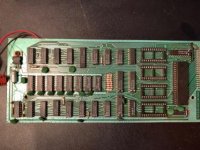
0CC0C9A3-353F-4BB5-AC34-277C4A104EDC.jpg

Cheers
Andy
 
Last edited:
Hello,

I have a 64k addon board made by Paradox Inc for the Commodore PET and wondered if anyone has come across it (I have spoken with JonB who also has one but with no documentation sadly) ?

I ran the 8296 diagnostic program which told me I have a few bad ram chips (bits 1 & 3) which I replaced and re-ran with no errors.

I then ran the board with my Supersoft HR40 hi res graphics programs and it worked fine.

This told me it works like the commodore supplied board though with a few exceptions.

The notable one being the extra ROM sockets which are either for paged ROMs or SRAM chips. When I plug in an eprom the memory space $9000-$afff is just filled with $FF’s.

A photo is below and if anyone knows of this product I would be grateful hearing from you.

View attachment 1063336

Cheers
Andy
Hi Andy,

I also have one of these boards in my commodore pet (cbm 4032). I have seen another picture online also on Dave Curran’s blog on Tynemouth here: http://blog.tynemouthsoftware.co.uk/2024/07/commodore-pet-64k-128k-ram-boards.html?m=1

I guess I maybe a few years apart from your message.

Also do you know where I can get the software you mentioned as I’d like to try both on mine

I think potentially some of the ram chips are faulty.

I’m guessing like mine it relocated the cpu 6502 to the daughter board.

I only figured this today as I unplugged it and notice the machine no longer powers on I assume this was common practice to swap out the cpu and extend functionality via the cpu socket

I don’t see another 6502 on the mainboard so I think this has to be the case

Mike
 
If the board is compatible with the 8096, you could give LOS-96 a try, in case you are looking for use cases for the board.
 
Hi all I hadn’t seen the replies till now and I’ve been having issues with repairing this board and it maybe responsible for causing problems with my pet..

Anyway long story short the paradox board looks to wire the ground and vcc to alternative reversed voltage. So pin 8 and 16 are swapped. If you look at the 7805 on the pic on tynemouth you can see pin 3 goes to what should be ground.

Anyone else noticed this?

How did these boards ever work or was there a none standard 4864.

So I did some more digging and again the 4164 (same chip type) on Williams machines also were reversed polarity


Vs


&


& here mentions the voltage mod


I put standard 4164 socketed the board and put it in my pet and now I’ve lost the upper bank of ram :(

I’ve ordered the parts to repair the pet but be warned if you go exploring with this board there maybe different voltage settings with these to standard.

In the mean time I’ll fix the pet and hopefully fix the ram board
 
I don't necessarily think the design is wrong - it is just that there are different pinouts of 4164 devices out there, and incompatible with each other...

If someone else has tried to 'fix' the card using the wrong pinout 4164 devices...

Pin 8 of the CPU connector cable is removed, thus the memory card is powered from its own +5V supply so the PET and memory board are not powering each other through a tiny Vcc pin on the CPU socket.

Dave
 
I don't necessarily think the design is wrong - it is just that there are different pinouts of 4164 devices out there, and incompatible with each other...

If someone else has tried to 'fix' the card using the wrong pinout 4164 devices...

Pin 8 of the CPU connector cable is removed, thus the memory card is powered from its own +5V supply so the PET and memory board are not powering each other through a tiny Vcc pin on the CPU socket.

Dave
Yep but it’s annoying when that person was me :)

Still it’s a learning exercise and now I know what went wrong i can fix it. I just wish I’d paid a little more attention and hadn’t assumed a particular chip would be the way to update and repair the card.

Still sometimes admitting to where you went wrong may help others
 
Yep, learn from the experience and move on...

You have the same problems with all sorts of memory devices - until some sort of Standard was agreed.

The problem with Standards is that the looser(s) end up changing their product lines to align with the Standard and this now limits the further availability of parts for the future.

I always try to look for disparate data sheets before buying parts. I do this as part of my job, so mistakes are very costly...

Most incompatibilities are signals, so no disaster scenario. But power rails, frying tonight!

Always good practice (if possible) to measure the voltages on the power pins to make absolutely certain.

I have a microprocessor PCB that is powered from a -5V supply with 0V being the Vcc pin! That caused me to scratch my head a bit before starting work. If I had connected my oscilloscope ground clip to what I had assumed was 0V, I would have shorted out the power supply before I had even started!

Dave
 
Last edited:
Oh, wow, that is really dumb. It looks though that some manufacturers called chips 4164 while they are almost compatible with what everyone else calls 4116, and not what everyone else calls 4164. Note that there are three voltages plus ground. All these are 16kbit chips.
I wonder if those pages mentioning that the weird 4164 has VBB=1, GND=8, VCC=9 and VSS=16 is even correct? VSS usually means ground.
A regular 4116 has the same pinout for pin 1,9, 16 while pin 8 is labeled VDD = +12V. (VBB=-5V, VCC=+5V).

The 4864 seems to have the same pinout as standard 4164 chips, i.e 64kbit and +5V on pin 8, GND on pin 16.

Exactly the same picture and pinout as on the jammarcade site you link to, but better quality seems to be on this site, which also says they are 64kbit chips but only shows A0-A6 = can only hold 16kbit (with the regular RAS/CAS addressing. No SDRAM for almost two decades...)
https://www.circuits-diy.com/4164-64k-video-ram-datasheet/
Archive.org says that there is only a capture in may this year of that site. No captures exist of the jammarcade site.
I wonder if the circuit-diy site is AI generated, and/or if the Jammarcade site on purpose puts up incorrect information to ensure whoever runs that site gets repair jobs but still gives the impression of being competent to anyone not looking that thorough? The fact that they deny archive . org mirroring feels slightly suspicious.
To give the benefit of doubt to jammarcade, maybe they actualy really know what they are doing and has no bad intentions, and accidentally used the pinout image from a bad site.

I wonder when someone will create a browser plugin that uses archive.org to check if a site existed before 2023...2024 and puts up a warning if there aren't any captures from before 2023/2024 (whenever AI slop exploded). Like before that there were loads of slop sites with "IT tips" and whatnot but those were just elaborate rewrites of actually correct information on how you do various mundane tasks in Windows and whatnot, but usually not incorrect information.

Google search for results before 2022 shows that jammarcade has been around since at least 2010, so I assume it's a legit site.
(Sorry if I've just accused a large archade site for shenanigans. I admit that I know next to nothing about arcade games. They are kind of in the margin of my interest sphere. I.E. the fact that they are microprocessor controlled devices that are kind of cool interests me, the fact that they are large and bulky and also expensive (="too" collectible) makes them obnoxious to me, and also I've never been much interested in games that weren't available on home computers at apporx the first half of the 80's).
 
I would only really trust the manufacturers' data sheets - not websites. Datasheets should have some sort of Quality Control applied at the source. Websites would generally have none.

However, if there are no manufacturers' daasheets available, you have no choice...

Dave
 
It’s a live and learn scenario, so some further info, it seems the Commodore 64 shared the same 4164 chips so I’ve sourced the correct type now and they are a better option than rewiring / modding small chips - that would be fiddly and not worth the effort and likely would eventually get knocked about at some time when I forget why I wired them that way.

So the chips I’ve ordered are these KM4164B
These match the same pin out.


Dave you are correct ! Always check the datasheet and don’t rely on just thinking something is pin compatible.

Other than this, I have gained some useful learning and also AI has assisted me in being able to wire up the ram card to a raspberry pi gpio pins to the 6502 socket ahead of putting it back into the pet.

So it should help validate the ram is good and all wiring is fine. Once I have proven that works I’ll share details of the wiring / scripts, should that be of interest. It’s a fun birds nest of DuPont cables and a few 330ohm resistors in Breadboard..

IMG_4623.jpeg

Obviously I don’t run it holding it in such a way but you get the idea :)
 
It’s a live and learn scenario, so some further info, it seems the Commodore 64 shared the same 4164 chips so I’ve sourced the correct type now and they are a better option than rewiring / modding small chips - that would be fiddly and not worth the effort and likely would eventually get knocked about at some time when I forget why I wired them that way.

So the chips I’ve ordered are these KM4164B
These match the same pin out.

That data sheet shows the pinout for every 4164 I've found that is actually a 64kbit chip, and not some weird 4116 with a pin labeled GND and a pin labeled VSS...

Which chip has the wrong pinout? 4864 seems pin compatible.

Btw the tynemouth page shows up with all broken images, and I need to manually click on each image to show the one that you say have a weird 5V regulator pinout. What is that picture called / labelled?
 
Looks like every other 4164.

Are we 100% sure that there isn't any confusion in the form that the board is intended for 4116 chips? That would explain fried chips, but then 4116 has three voltage rails so you'd have to check the pinout anyways.

As I said, the pinout used on the arcade repair blog post seems to originate from an incorrect web site. from may this year.
 
Back
Top