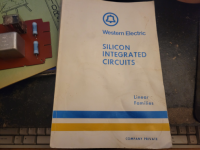
Had some time this evening so decided to finally do some scans I've been meaning to for a while.
The MAC-4 is a one-chip, totally self-contained microcomputer primarily designed for controller system applications. It is implemented in CMOS technology for...
archive.org
This is the MAC-4 Specification Sheet (Preliminary, 11/78). The MAC-4 is a 4-bit microcomputer that was used in numerous telephone applications such as PBX systems and central switching peripherals. Much early info about this and its earlier 8-bit relative the MAC-8 can be read in the 1976 BTL/WE Microcomputer Symposium papers (
https://bitsavers.org/pdf/westernElectric/BTL_WE_Microcomputer_Symposium_Dec76.pdf). It can also be read about in brief in the BSTJ (
https://bitsavers.org/magazines/Bell_System_Technical_Journal/BSTJ_V58N04_197904.pdf page 153 in the PDF).
This is only a part of the documentation Bell Laboratories produced. Luckily with the MAC-8 documentation I found this stashed with there was also an ordering sheet that lists:
MAC-4 Programmer Manual
MAC-4 User Manual
MAC-MATE Manual
With the latter being a development board much like the MAC-TUTOR is for the MAC-8. A prototyping module, "PROMAC" is also mentioned in the specification sheet, but these are the only additional MAC-4 mentions I have found in this particular set of documents. I've got a stack of Dataphone modems I intend to open up soon to see if any of them might have a MAC-4 inside. Pipe dream but I'd love to find one and figure out how to use it.
The MAC-8 is a single chip, bus-structured general purpose microprocessor with an 8-bit data bus and a 16-bit address bus.PRELIMINARY DRAFT
archive.org
And since I got it scanned while preparing this one, have also the 212B MAC-8 Single-Chip Microprocessor Package Data Sheet (Preliminary, 09/78).
The MAC-8 is an 8-bit microprocessor that was similarly used in a number of Western Electric products such as switching systems and modems. This one is a little more documented already, what with many MAC-TUTORs having surfaced over the years. I happen to have two of them, both fully functional as far as I can tell. It was with one of those units that I got these and a few other documents.
Additional documentation for the MAC-8 includes:
MAC-TUTOR Reference Manual (
https://bitsavers.org/pdf/westernElectric/mac-8/PA-800515_MAC-8_TUTOR_Jul79.pdf)
MAC-TUTOR Self-Training Manual (
https://bitsavers.org/pdf/westernElectric/mac-8/PA-800516_MAC8_SelfTraining.pdf)
MAC-8 Hexadecimal Coding Chart (
https://bitsavers.org/pdf/westernElectric/mac-8/PA-800517_MAC8_Opcode_Dec78.pdf)
MAC-8 Processor User's Manual (Unscanned, but I have one I plan on scanning)
MAC-8 Programming Manual (Unscanned)
PLAID User Manual (Unscanned)
PLAID Hardware Manual (Unscanned)
With the PLAID being another MAC-8 development system. Attached is a bit of PLAID information from the MAC-8 Processor User's Manual.
Aside from all of this, the only other documentation (outside of thus far esoteric BSTJ mentions) I have in my library on these are in some Bell Labs UNIX 5.0 and SVR2 manuals, specifically BTL-internal manuals with a number of extra utilities. Among these are "m8" and "m4" prefixed development tools like compilers and assemblers (e.g. m8cc, m4as, m4ld, m8sim). I eventually intend to write my own replacements for these tools to work with the MAC-TUTOR and hopefully eventually a MAC-MATE, PROMAC, and/or PLAID. Unfortunately the MAC-4 assembly language remains obscure, the specification sheet only has descriptions of the operations and their parameters, not mnemonics or any other syntactical details. If it's anything like MAC-8, it resembled C more than a conventional assembly language. Bell Labs was experimenting with designing extremely C-like CPU architectures at this time, so something a little more C-ish than assembly-ish to express low-level operations makes sense.
Anywho, enjoy, certainly interested in other folks's thoughts and experiences with early WECo CPU technology!
P.S. If you want more MAC-8 info, check out this page:
Hopefully as I experiment with mine I can supplement the information.