• Please review our updated Terms and Rules here

IBM PC XT 5160 BIOS versions

I've tested with BIOS (08/16/82) on 5150 machine. (Of course IBM PC 5150/5160 emulator.)

It works well.

I think this BIOS is for IBM PC 5150 than 5160.

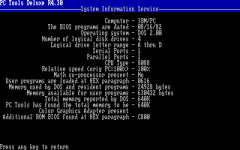
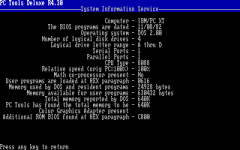
I've run PC-Tools on 5160 machine configulation with this BIOS.

The result is on screenshot.

e6fr.png


According to PC-Tools, it recognize as IBM PC (Not IBM PC XT)

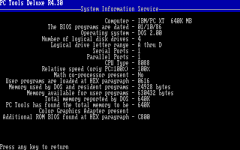
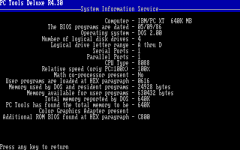
But PCTools recognize as IBM PC-XT correctly on BIOS (11/08/82)

nvws.png
 
Just looked at the 5160 MB that I replaced the 12v line caps on.

This is a IBM 256 - 640 system board

U18 = 62x0890
U19 = 68x4370
dated 1986 no month shown

Chips stamped IBM
 
can I upgrade my 5160 XT (256KB board) to accept the new bios which supports 720K and 1.2mb disk drives? What is involved? Right now I have to use a card with onboard bios to utilize a 1.44 drive.
 
I'm wondering if it's possible to "upgrade" a clone PC-XT by changing its ROM chip for an IBM one ?
 
Many generic ERSO style XT clones will happily accept IBM ROMs so people could add IBM BASIC. But not all clones are that hardware compatible. Doing that may not work at all or lose smaller features that were added to later clone BIOSes (For example, commonly in turbo 8-mhz 8088 boards you can lose keyboard turbo switching).
 
For anyone interested, I want to confirm that the ATMEL AT27C256R-45 One Time Programmable is compatible with the IBM 5160 64K-256K motherboard using the Mostek MK38000, though the machine does not benefit from the faster ROM as far as I can tell. The November 8th, 1982 BIOS was tested.
 
can I upgrade my 5160 XT (256KB board) to accept the new bios which supports 720K and 1.2mb disk drives? What is involved? Right now I have to use a card with onboard bios to utilize a 1.44 drive.
I'd like to bump this post - I have a older 5160 board that has the MK37000 and MK38000 - its a 64K-256 board upgraded to 640K - I have attempted to burn the May 86 5160 bios to U18 and U19 and I cannot get the system to POST - I have used the older 11/82 BIOS and it boots fine. I have also made XTMEMTEST and the Ruud's test ROMs without issue - I am also trying to use the 27C256 Chips from TI - they are true chips and haven been UV erased prior to programming - I have also verified the contents of the ROM's when I have burned them -

Anyone have any idea if The May 9 1986 ROM from minus zero's website is useable? I am not sure I am doing anything wrong as I am using the 32K ROM files from the site -
 
Anyone have any idea if The May 9 1986 ROM from minus zero's website is useable? I am not sure I am doing anything wrong as I am using the 32K ROM files from the site -
You will be referring to the web page at [here]. I just now put the 05/09/86 revision from that page into PCEM v17, and watched PCEM boot into Cassette BASIC.

I'd like to bump this post - I have a older 5160 board that has the MK37000 and MK38000 - its a 64K-256 board upgraded to 640K - I have attempted to burn the May 86 5160 bios to U18 and U19 and I cannot get the system to POST - I have used the older 11/82 BIOS and it boots fine. I have also made XTMEMTEST and the Ruud's test ROMs without issue - I am also trying to use the 27C256 Chips from TI - they are true chips and haven been UV erased prior to programming - I have also verified the contents of the ROM's when I have burned them -
Looking at the diagram at [here], one of the differences between the '82 and '86 dated BIOS' for the IBM 5160, is that in the '86 versions, the BIOS is extended into ROM U19. I wonder if there is a problem with the U19 socket/soldering (or tracks to it).

With the 11/08/82 revision BIOS in place, if you run the 5160ROMS tool at [here], does 5160ROMS give the expected result?
I.e.
1779928321283.png
 
You will be referring to the web page at [here]. I just now put the 05/09/86 revision from that page into PCEM v17, and watched PCEM boot into Cassette BASIC.


Looking at the diagram at [here], one of the differences between the '82 and '86 dated BIOS' for the IBM 5160, is that in the '86 versions, the BIOS is extended into ROM U19. I wonder if there is a problem with the U19 socket/soldering (or tracks to it).

With the 11/08/82 revision BIOS in place, if you run the 5160ROMS tool at [here], does 5160ROMS give the expected result?
I.e.
View attachment 1322625
Let me get the older BIOS installed back in the machine and I will report back shortly..... yeah I did see the memory space was spread - which got me thinking that perhaps I was burning the rom's incorrectly - standby and I will go check -

In the meantime I think I need to read more about PCEM ..... first time I am hearing about it :)
 
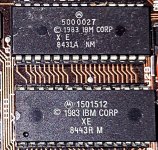
I'm beginning to work on my dad's old XT/370, and I discovered a U18 rom which doesn't seem to match anything online. U19 matches the 08NOV82 5000027 rom which is floating around, and U18 (1501512) has the "11/08/82" date in the bottom as well as a "1501512 COPR. IBM 1981" inside, but is not even close to the BASIC ROM 1501512 that's online - in fact I don't think it contains BASIC at all, since I don't see the command list in strings.

In my memory, we only ever used this computer for DOS, so we wouldn't ever hit BASIC (or lack thereof) - my dad removed the set of 3 370 cards before I was born so we never tried that out, but getting those working is my goal for this machine - all that to say, I suspect the ROM is something to do with the 370 system, but I've never actually booted it to be sure.

I've placed it here if anyone wants to take a look / share it elsewhere. Let me know if you'd like more info or anything.
 

Attachments

  • IMG_1376.jpeg
    IMG_1376.jpeg
    4.1 MB · Views: 12
For a little background: I assume this machine boots and that a "regular" XT can boot with these ROMs installed. Correct?

Thoughts are to try to boot these in an emulator and compare the state of the system immediately after booting to a stock XT, and then try to disassemble the ROM and see what's different. This brings up a thought - nobody's ever made an XT/370 emulator yet, but it might not actually be that hard to do with a full set of ROMs and associated software.
 
Update: the dump appears to be aliased (like address line 14 was stuck high). It's otherwise identical to BIOS_5160_08NOV82_U18_1501512.BIN.

(That's good news, since it means the XT/370 doesn't have funny ROM.)
 
Sure enough - I didn't read the datasheets carefully enough, and tried to read it as a 27C256 - with A14 on the wrong pin. It definitely does match the existing copy of 1501512. I even looked for something like that happening in the files and totally missed it on my first pass!

Nothing that I can see is special about the motherboard (a 64-256K, in fact I have a theory that the 256k-640k board is incompatible, since the memory card is exposed to DOS as well as the 370)- the only bodges are a much neater version of this, which I can confirm matches the '86 technical reference (updated vs. the '82) - some change to the XIOW' logic.

This all jives with the info I find online - you could order the machine factory as an XT/370, or they sold an upgrade kit, which was just the three boards (PC/370-P and PC/370-M tied together, and P/C 3277EM next to it) and the front badge, along with some software. Unfortunately, I don't have the software, but I'm hoping I can scrounge up enough of it to get something working.

...in any case, there are no ROMs on any of those three boards. I suspect the hardest part of building an emulator would be reverse-engineering the 3 CPUs - each is a chip built specifically for this card. Two are apparently modified 68000s (contemporary documentation suggests: either 1 is microcode-modified, and the other is standard and emulates the other instructions, or else one is for instruction decode, and the other is for everything else and they're both special), and a modified 8087 for floating-point instructions.

Chip U24 (the 8087) is a CERDIP-type, reading: "4767561 8331 / PI M P A02370 / F335802D / (C) INTEL '82" with an Intel "i" to the left.
Chip U62 (a 68k) is a square ceramic package, reading "(Motorola logo) 8519386 / XE 328775 / CG88329E MD / SC81181R8"
Chip U63 (similar to U62), reading "(Motorola logo) 4481512 / XE 331092 / CC18349A MD / SC81171R"
 

Attachments

  • IMG_1381.jpeg
    IMG_1381.jpeg
    3.6 MB · Views: 11
  • IMG_1382.jpeg
    IMG_1382.jpeg
    319 KB · Views: 10
I wonder what software the 68ks are running. Maybe the software loads the S/370 emulator into RAM and the 68k just runs that.

I would be surprised if the chips were heavily modified, considering how expensive that would be.
 
You will be referring to the web page at [here]. I just now put the 05/09/86 revision from that page into PCEM v17, and watched PCEM boot into Cassette BASIC.


Looking at the diagram at [here], one of the differences between the '82 and '86 dated BIOS' for the IBM 5160, is that in the '86 versions, the BIOS is extended into ROM U19. I wonder if there is a problem with the U19 socket/soldering (or tracks to it).

With the 11/08/82 revision BIOS in place, if you run the 5160ROMS tool at [here], does 5160ROMS give the expected result?
I.e.
View attachment 1322625
So sorry this took so long to get back to you - but - I wanted to be sure I could run the 5160ROMS file and screen capture it - the result is - YES the U18 and U19 ROMS are seen with the 11/08/82 ROMS installed in the 5155 (aka 5160) MB

Screenshot 2026-06-09 at 15.06.37.png


So - I have also looked at the minuszero site to ensure I am using the correct ROM EEPROM's - I am NOT however using an adapter for each of the 27C256 ROMs that I am burning - they are ST chips and were UV erased prior to programming - I have ensured I have the U18 on one (and labeled) and U19 on the other (also labeled) I am burning the roms from the site without any modification to the memory space or "ROM IMAGE" duplication -

so if anyone has any insight as to what the proper process should be to burn these ROM images - I have a TL-866 which has been rock solid for many years ;)

Thanks in advance everyone!
 
Back
Top